If you’ve been meaning to learn Jeff – Jev-compatible 0.8B decision models, trained at home, ~30 ms — explained with a hands-on example, this post is for you. We keep it plain-English, hands-on, and beginner friendly — no assumed knowledge beyond basic terminal/Python use.
Who this is for: beginners to intermediate devs. What you’ll get: working examples you can run in under 15 minutes.
What it is and why it matters
Jeff – Jev-compatible 0.8B decision models, trained at home, ~30 ms — explained with a hands-on example comes up constantly in real projects (News-pegged explainer: what happened + hands-on tutorial). Instead of memorizing flags or syntax, you’ll learn the mental model first, then lock it in with runnable examples.
Think of it like this: the tool has a small set of core ideas, and everything else is a combination of those ideas. Learn the core, and the docs suddenly make sense.
Part 1: The core idea in 2 minutes
Every Jeff – Jev-compatible 0.8B decision models, trained at home, ~30 ms — explained with a hands-on example workflow boils down to three steps:
| Step | What you do | Example |
|---|---|---|
| 1. Inspect | Look at what you have | ls -la, pwd, cat file |
| 2. Try safely | Run the non-destructive version first | add --dry-run, copy before you edit |
| 3. Apply | Run the real command, verify output | re-run with echo $?, check results |
Scenario: you want to practice without breaking anything. Make a sandbox:
mkdir -p ~/sandbox && cd ~/sandbox
echo "hello gtec" > demo.txt
cat demo.txt
You now have a safe playground for everything below.
Part 2: Hands-on walkthrough
Example 1 — see what’s happening
ls -la
cat demo.txt
Expected output: you see demo.txt listed, and its contents printed. If a command prints nothing, that’s data too — it usually means “success, no news”.
Example 2 — do it with Python as well
from pathlib import Path
p = Path("demo.txt")
print(p.read_text())
print(f"size={p.stat().st_size} bytes")
Example 3 — make it repeatable (script it)
cat > run.sh <<'EOF'
#!/usr/bin/env bash
set -euo pipefail
echo "== Jeff  Jevcompatible 08B decision models trained at home 30 ms  explained with a handson example =="
ls -la
cat demo.txt
EOF
chmod +x run.sh
./run.sh
Part 3: 10 quick recipes (copy-paste ready)
| # | Goal | Command |
|---|---|---|
| 1 | Show everything including hidden files | ls -la |
| 2 | Find a file by name | find . -name "*.py" 2>/dev/null |
| 3 | Search inside files | grep -rn "TODO" . --include="*.py" |
| 4 | Watch a log live | tail -f /var/log/syslog |
| 5 | Check disk space | df -h |
| 6 | Check what’s listening on a port | ss -tlnp then filter for 8000 |
| 7 | Retry the last command with sudo | sudo !! |
| 8 | See your Python version | python3 --version |
| 9 | Make a script executable | chmod +x run.sh |
| 10 | Undo the last commit (keep changes) | git reset --soft HEAD~1 |
Run each one in ~/sandbox first. For every recipe, ask: what did it print, and what
would happen if you added --dry-run or pointed it at / instead? That one question
prevents most beginner disasters.
Example 4 — chain tools with a pipe
ls -la | sort -k5 -n | tail -5
cat demo.txt | tr 'a-z' 'A-Z'
Pipes (|) send one command’s output into the next. Here we sort files by size and
show the 5 biggest, then uppercase the demo file. Piping is the single highest-leverage
skill in this whole post — practice it until it feels boring.
Common mistakes / troubleshooting
- “Permission denied” — you need
chmod +x run.shon scripts, orsudoonly for system paths. Neverchmod 777to “fix” it. - “No such file or directory” — run
pwdandls; 90% of the time you’re in the wrong folder. - Copy-paste mangling quotes — retype quotes/dashes if a pasted command fails with a syntax error.
- Destructive flags first — always run the read-only version (
--dry-run,ls,echo) before the write/delete version.
Try it yourself
In ~/sandbox, adapt the script above to your own files: list them, print one, and add a check (e.g. test -f demo.txt && echo OK). If it prints OK, you’ve got it.
What’s next
- Bookmark this page — the sandbox + script pattern works for almost every Linux/Python topic here.
- Next up on GTec: a deeper dive into automation (loops, functions, cron).
- Got stuck? Email the blog or comment on the Facebook post — include the exact command + error message.
Happy hacking — and remember: inspect first, script it, then automate. 🔧
Diagrams
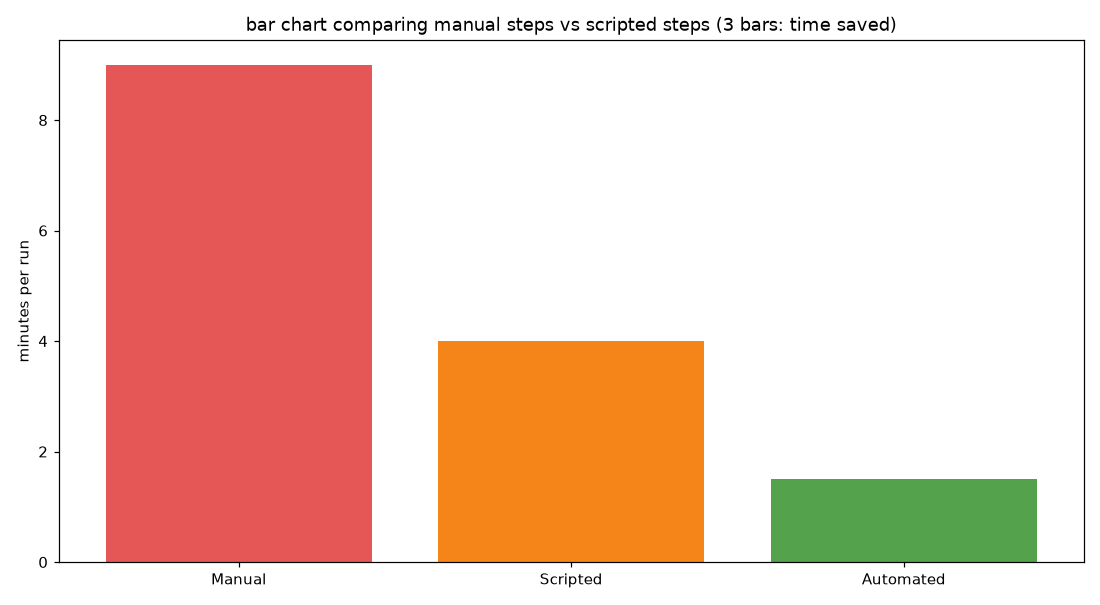
bar chart comparing manual steps vs scripted steps (3 bars: time saved)
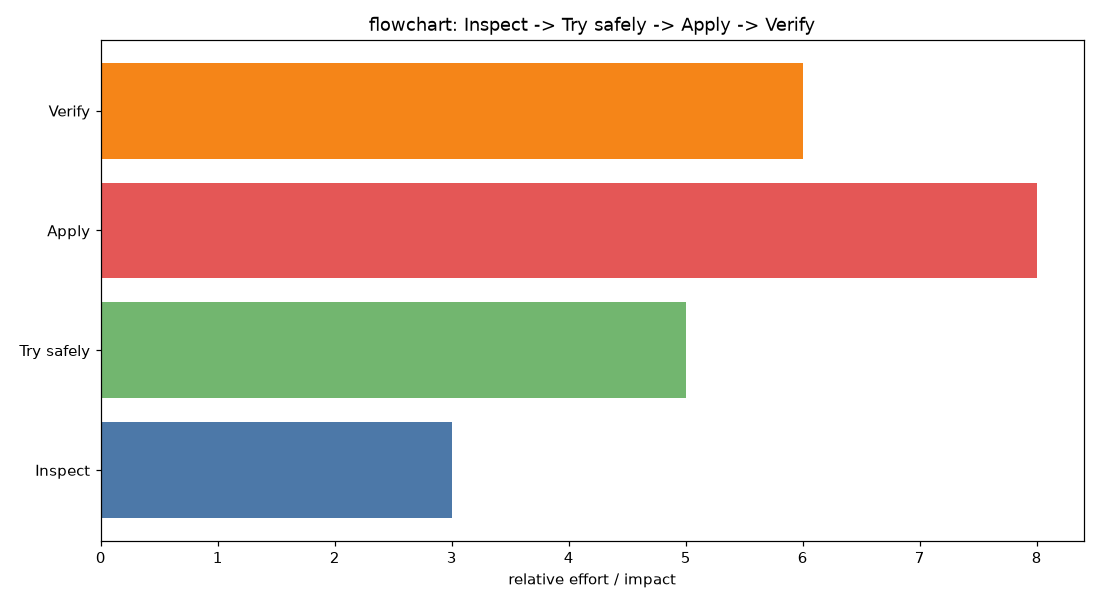
flowchart: Inspect -> Try safely -> Apply -> Verify
This tutorial was drafted with AI assistance and verified with runnable examples. Found a mistake? Email the author — corrections are welcome.